Savoir-faire (Know-how) in Psychoanalysis - A full-day seminar with Dr. Luis Izcovich
Speakers
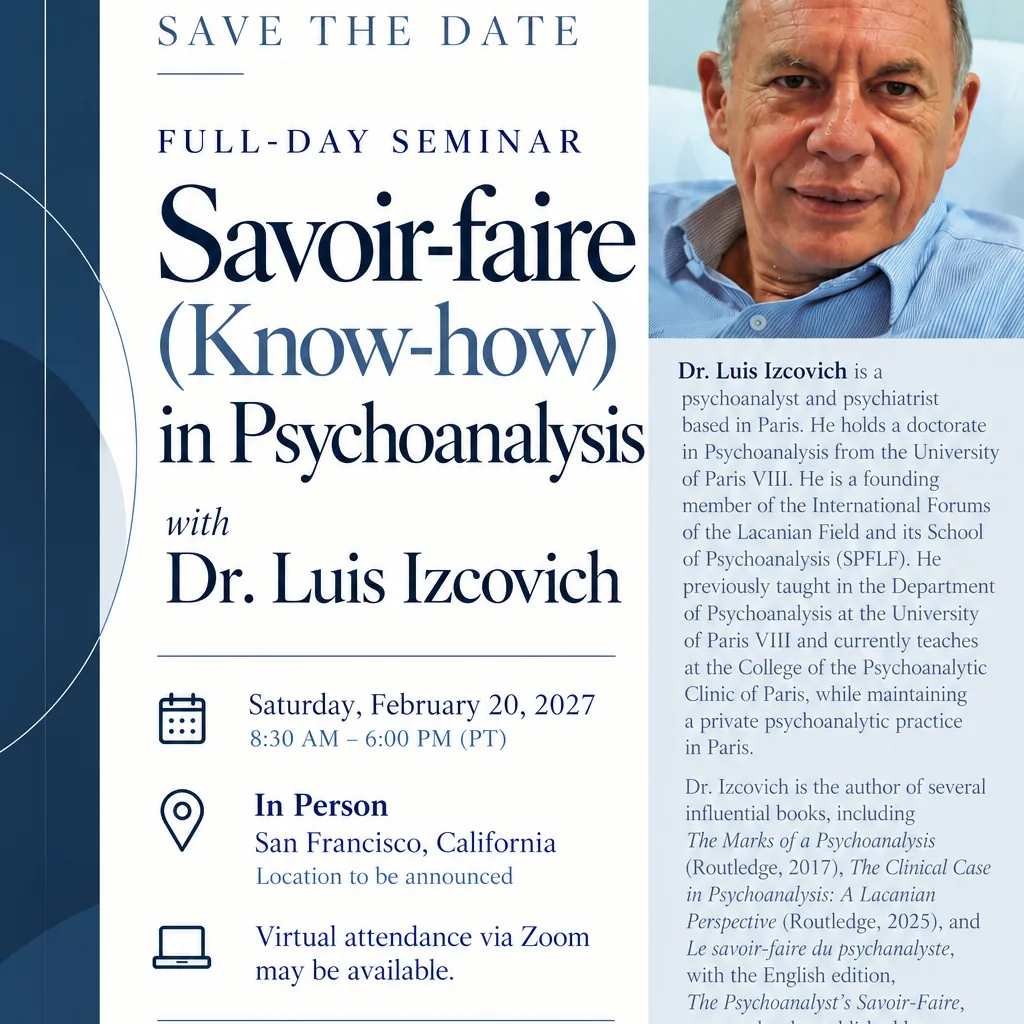
Dr. Luis Izcovich
Dr. Luis Izcovich is a psychoanalyst and psychiatrist based in Paris. He holds a doctorate in Psychoanalysis from the University of Paris VIII. He is a founding member of the International Forums of the Lacanian Field and its School of Psychoanalysis (SPFLF). He previously taught in the Department of Psychoanalysis at the University of Paris VIII and currently teaches at the College of the Psychoanalytic Clinic of Paris, while maintaining a private psychoanalytic practice in Paris. Dr. Izcovich is the author of several influential books, including The Marks of a Psychoanalysis (Routledge, 2017), The Clinical Case in Psychoanalysis: A Lacanian Perspective (Routledge, 2025), and Le savoir-faire du psychanalyste, with the English edition, The Psychoanalyst's Savoir-Faire, expected to be published by Routledge in February 2027. He also serves as Director of Éditions Stilus. His extensive scholarly work includes numerous books and articles published in English, French, Spanish, Italian, and Portuguese.
About
The Lacanian School of Psychoanalysis presents a full-day seminar with Dr. Luis Izcovich exploring the psychoanalyst’s savoir-faire and its clinical consequences. The program will include lectures by Dr. Izcovich and two clinical moments—presentations of fragments or particular moments from an analysis, each highlighting a different aspect or concept of the analyst’s savoir-faire. Each clinical moment will be followed by a discussion led by Dr. Izcovich. Clinical presenters, discussants, and chairs will be announced. The day will conclude with Dr. Izcovich’s remarks on the seminar’s central theme.
The unconscious knowledge that emerges during the analytic cure is an articulation forged from the impossibility of knowing about sex. Indeed, there is such a thing as unconscious knowledge. The subject knows more than they believe they know. Yet, the unconscious leaves the subject in a state of indeterminacy. The unconscious is not the suture that produces unity; rather, it reveals the subject's fundamental structure as divided. For the knowledge produced by the unconscious is a form of knowledge based on avoidance, constructed by forging myths that veil what proves to be impossible regarding the sexual.
Given these premises, it becomes essential to define the dimension of savoir-faire—or know-how—in psychoanalysis. Let us begin by clarifying what this term denotes. It does not refer to acquired or innate talent, nor is it a gift or a technique mastered in the way a craft is passed from master to apprentice. The psychoanalyst’s savoir-faire concerns the very status of the analyst and the actuality of their practice. It is, above all, a matter of Lacanian clinical practice—a practice that must constantly renew itself by taking into account the subjectivity of our times. That is why, in this seminar, we attempt to define the structural nature of analysis by linking it to the context of our contemporary discourse.
The essence of the subject's experience lies in a savoir-faire regarding the failure of sexual difference to be inscribed within the unconscious. There is, therefore, a response from the subject to the sexual. This response is always symptomatic. As Lacan indicates at the end of his teaching, savoir-faire in psychoanalysis—rather than a technique of mastery—is an arrangement with pudeur, modesty, specifically what Lacan states as "primordial modesty » (1). In relation to this modesty, all knowledge is established within an unsurpassable horror, facing the place where the secret of sex lies. This is the meaning of his proposition: knowing how to handle one’s symptom is knowing how to handle sexuality. After addressing "supreme modesty," Lacan discusses it in terms of virtue, which means an ethics : "The only virtue, if there is no sexual relation, is modesty. » (2)
This seminar aims to demonstrate the clinical consequences of this elaboration.
1- The translation in English of the French word, pudeur, usually as modesty needs to be clarified.
2- Lacan J., The Seminar, Book XXI: Les non-dupes errent (lesson of March 12, 1974), unpublished.
Virtual attendance via Zoom may be available.
Continuing Education (CE) credits will be offered.
Additional program and registration details to follow.
Continuing education
CE credits available.
In person
San Francisco, California · Location to be announced
Questions: programcommittee@lacanschool.org
Event details
- Date
- Time
- –
- Location
- San Francisco, California · Location to be announced
Fee
To be announced.
Registration is closed.